

NORTHERN VIPER (Vipera berus)
The Northern viper can be recognised by the zig-zag pattern on it’s back. The snake is the only viper (venomous snake) in Norway. The Northern viper belongs to the Viperidae family, and has two venomous fangs in it’s upper jaw.
The viper is a relatively short and thick snake, where the female (approximately 70 cm) can grow a bit longer than the male (approximately 60 cm).
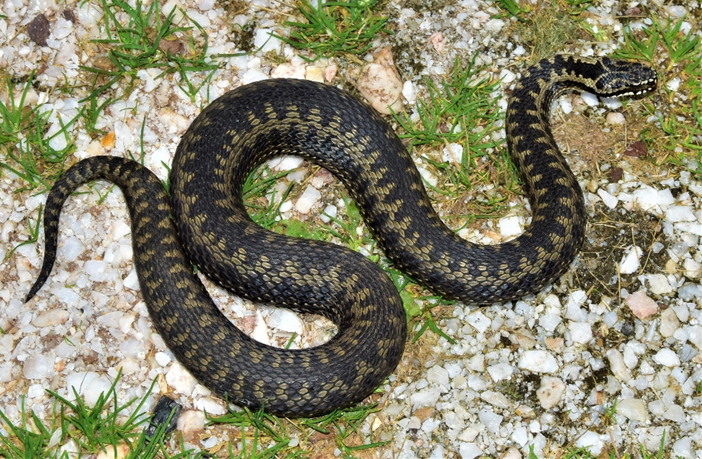
Melanism
Some Northern vipers are completely black, a phenomenon called “melanism”. These black vipers are common along the south coast of Norway. Further into the country, for example in Setesdalen, the brown and grey vipers are more common.
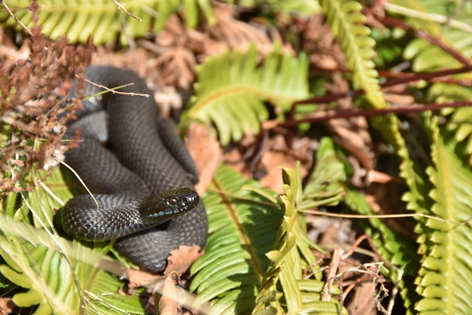
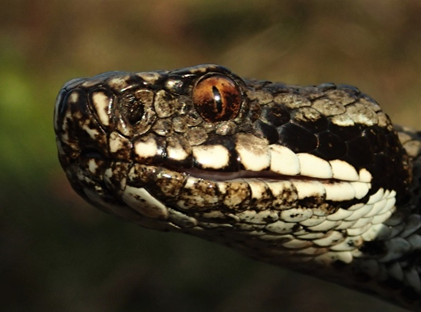
The Northern viper has an angry look
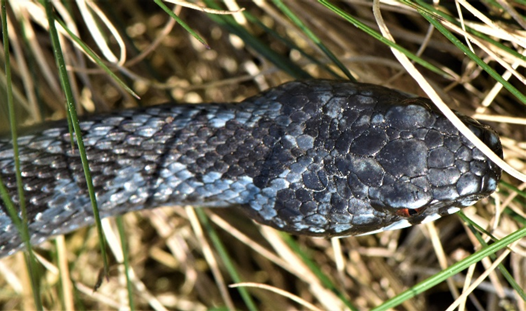
The Northern viper can appear angry, which is due to an eyebrow-looking scale, placed just above the eye. Another feature that contributes to the angry apperance, is the vertical lined pupils, and the reddish eye colour. The Colubridae family (smooth snake and grass snake) have round pupils, making them appear kinder and more innocent.
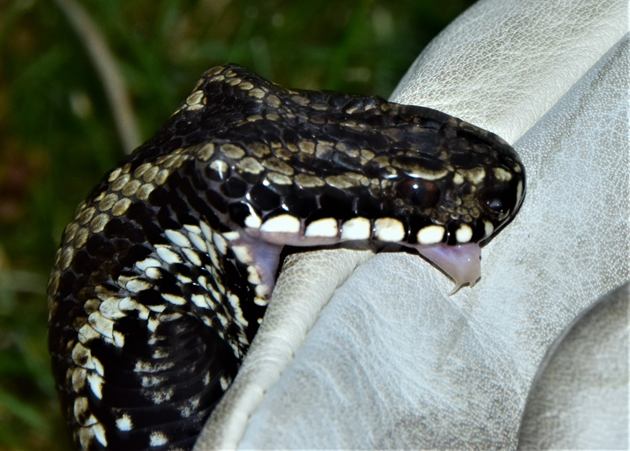
Venom
The two hinged fangs are located in the upper jaw, they fold at the base to lie against the roof of the mouth. They are bent backwards, when they are not in use, muscles bend the fangs forward when they are about to bite.
The venom is stored in two venom glands located in the palate, one behind each eye. A tiny tube extends from the glands and releases the venom through a hole on the tip of the fangs. The bite itself only takes 1/40th of a second. This is so quick that the eye of a human will not see it. If you are bitten by a Northern viper, you need to seek medical attention. You should try to move as little as possible to keep the venom from spreading.
Fortunately, the Northern viper does not always use it’s venom when biting. Bites without venom are called “dry bites”. The viper’s fangs are short, with 3-5 mm as the longest they can grow. Thick wool socks or shoes will therefore be enough to stop the fangs from reaching your skin.
The Northern viper is the snake with the largest distribution in the world
The Northern viper (Vipera berus) is the snake species in Norway with the largest distribution within the country. The viper is found even in furthest north in Nordland county and up to 1000 meter above sea level. The viper also has the largest distribution of any land based snake species, which is mentioned in the Guinness World Records!
The species is to be found from the West of Great Britain to the Sakhalin Island in East Russia, from the polar circle in the north, to the Mediterranean in the south, where it can thrive at up to 2600 meters above sea level.
What does a viper eat?
You might think that a viper only eats mice? Actually, vipers eat a lot of different animals. A viper can crawl into a bird nest and eat chicks. They can also eat small lizards, slow worm, frogs, salamanders and shrews. Fully grown individuals usually prefer mice. During one summer, a viper can eat up to 25 medium sized mice! A viper can empty an entire mouse nest! So if you want to stay clear of mice, having vipers close to your house or cabin is a good thing!
The male vipers appears earlier in Spring than the females
The Northern viper is the first of the Norwegian reptiles to come out from hibernation during Spring. It might even appear as early as January/February during mild Winters along the coast. The males are always the first to appear. They need to shed skin and mature sperm cells before the females come out of hibernation 2-4 weeks later.
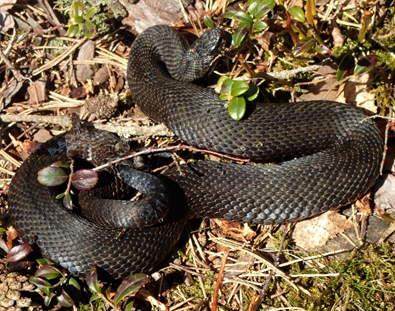
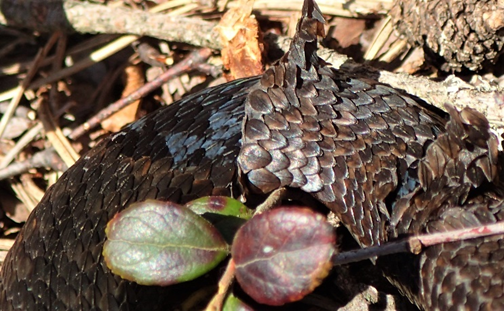
Before the males shed skin first time during spring, they often look single colour – black or brown. At the picture above you can see the new skin beneath the old skin. The new skin is blue with zig-zag pattern. Males typically gets blue, purple, turquise or grey skin with black zig-zag pattern during mating season.
The viper has multiple, small scales on the top of it’s head. These scales can be used to distinguish each viper, as the scales of each individual have different shapes and patterns.
The Northern viper and the grass snake both have keels on their scales
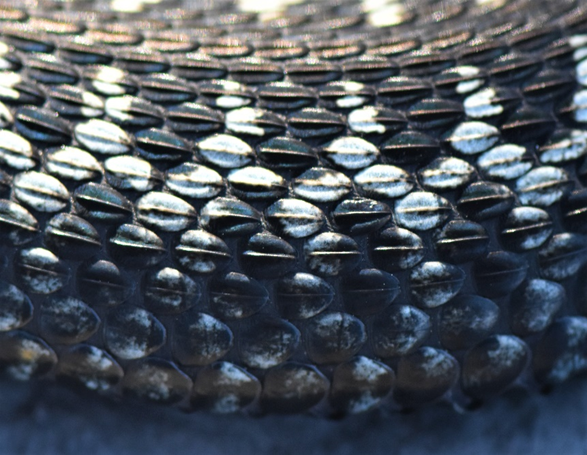
The Northern viper and the grass snake both have keels on the scales on their back. A keel is a lined ridge in the middle of the scale. These keels create a more rough texture to the snake skin, you can feel this if you touch the skin. The smooth snake does not have these keels, making it more “smooth” to touch, thus giving the snake it’s name. Therefore, the keel can help you determine the species of a snake, even if you have just got the skin!
A viper’s love life
When the female vipers wake up from hibernation 2-4 weeks after the males, the males are covered in beautifully coloured mating-skins, ready to fight for the females.
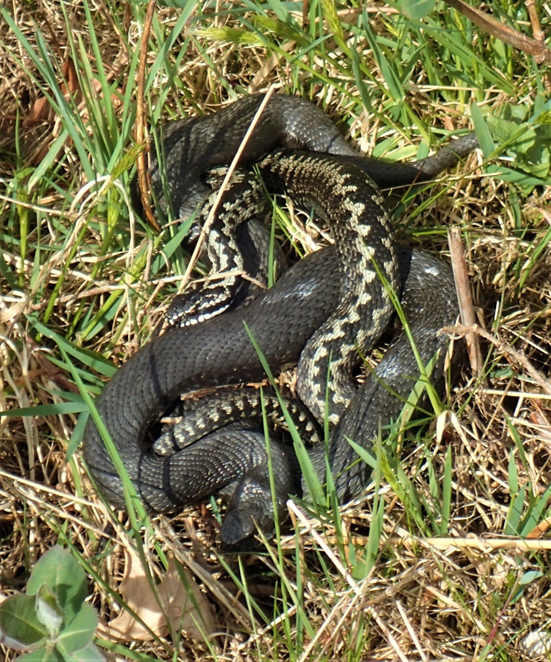
The viper mating battle is famous, if you get to see one, consider yourself to be very lucky! The males will wrestle by twining together, and trying to force the other viper to the ground. The loser sneaks away, while the winner get to mate with the female.
As the other snakes in Norway, the northen viper gives birth in late Summer or early Autumn. The Northern viper and smooth snake both birth live youngs, the grass snake lays eggs.
Text and photo: Beate Strøm Johansen