

SMOOTH SNAKE (Coronella austriaca)
The smooth snake is Norway’s rarest snake, and the only Norwegian reptile on the red list of threatened species. The species is fond of heat and is therefore to be found in south facing and sunny coastal areas. These are the same areas people tend to live and build houses and cabins.
The smooth snake is also particularly fond of it’s home, and will stay within approximately 0.5-1 square kilometre of it’s home. This results in a poor ability to colonize. A smooth snake population is therefore usually quite isolated from others, and often consists of only 10-20 adult individuals. A population is as a result vulnerable to eradication. Only two places in Norway do we know about smooth snake populations of about 100 adults. These two places are under pressure from the respective communes or groundowners that wants to build houses there.
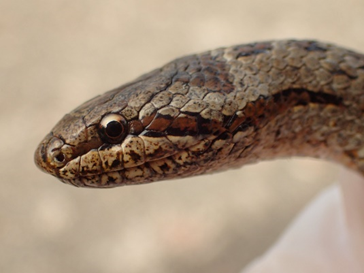
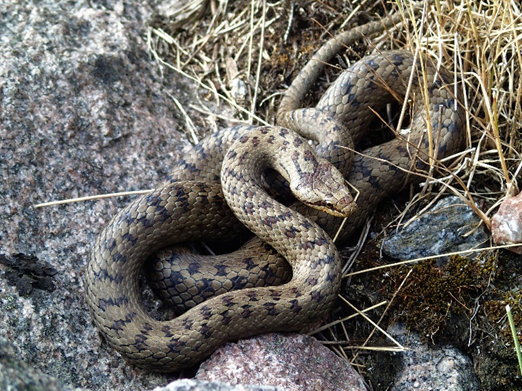
How to recognise a smooth snake
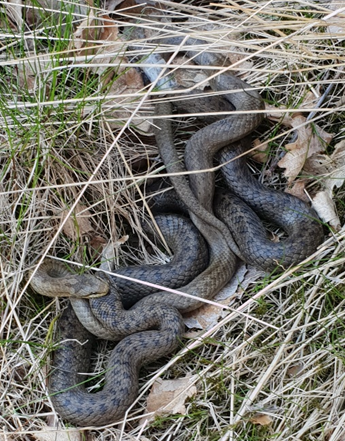
The smooth snake is a grey-brown and slim snake, measuring approximately 75 cm in length. At first glance the smooth snake can be easily mistaken for a brown Northern viper. The Northern viper has a darker zig-zag pattern on it’s back, compared to the smooth snake which has pairs of dark spots parallel down it’s back. It is also recognisable by the dark spot on the head and the line across its eyes. The first 10 cm of the spotted pattern on the back is unique to each individual. Photos can therefore be used to distinguish each one.

Why is it called «smooth snake»?
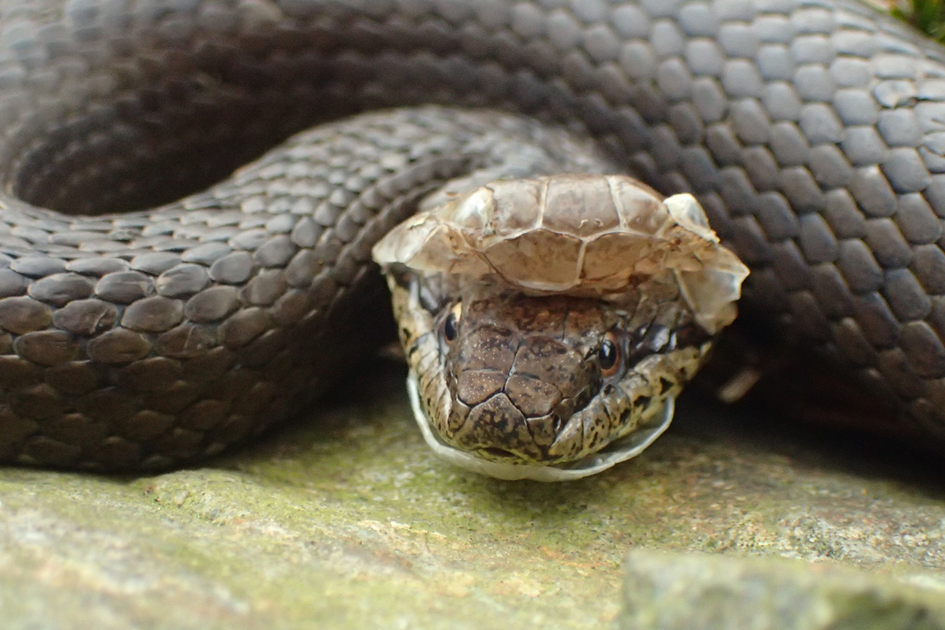
The smooth snake is so named after the smooth scales on it’s back. The European grass snake and the Northern viper both have keeled scales on their back, making them appear and feel more rough. This is also visible on snakeskin which has been shed. If you look for the keel, it is possible to determine whether it is a smooth snake’s snakeskin or one of the two other species mentioned. If there is a narrow ridge on each scale, then it is not a smooth snake.
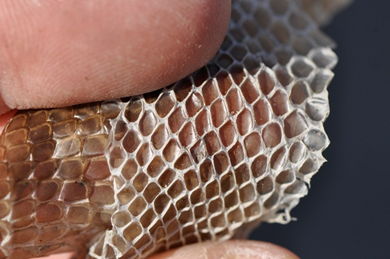
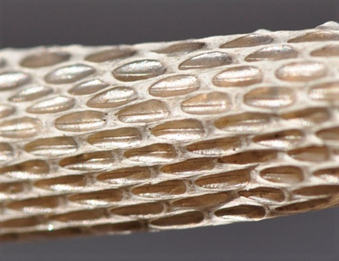
The old snakeskin will first loosen around the upper lip of the snake, and then pull backwards and inside out, in one piece when the snake moves through vegetation and narrow cracks. Snakeskin is therefore always found inside out
What does a smooth snake eat?
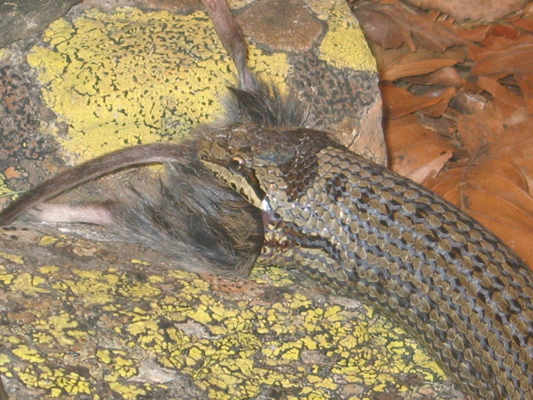
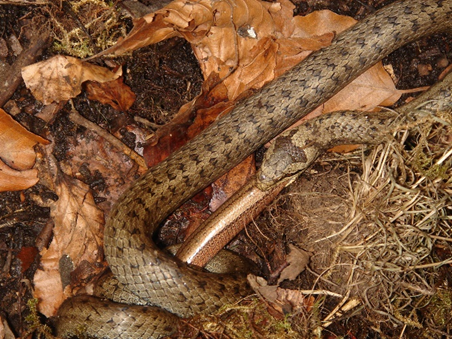
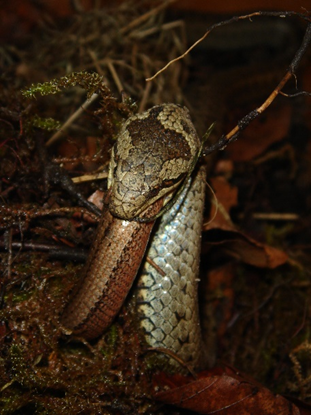
Norwegian smooth snakes mostly eats slow worms and shrews, as well as mice. It can also eat Northern vipers, lizards, bird eggs and newly hatched chicks. Sometimes cannibalism may occur. The smooth snake is a type of constrictor, which will wrap tight around its prey and attach itself with a bite. The prey will normally be eaten head first, and it does not need to be dead before the snake swallows it. The smooth snake is not venomous.
Reproduction: From mating to birth
Mating between the smooth snakes typically happens during Spring, in May-June. However, mating during Autumn can happen occasionally. When mating, the male, will attach itself to the female and bite around the females head. Their bodies stay relaxed while mating. It is rare to spot a smooth snake copulation, so if anyone is lucky enough to get a photo of the event, please share it with Beate Johansen. You can also report you findings, as well as attached pictures, at www.artsobservasjoner.no.
The gestation is quicker if the weather is warm, and will last 2-3 months. The snakelets (1-14) are usually born in August-September. They weigh 3 grams and are 20 cm in length, and has an orange belly. The colour on their back is grey with a black dot pattern. The brown colour first appear after the snake is 1-2 years old. The newly born snakelets stay together where they were born the first days after the birth.

In Norway, the females typically give birth every second year. However, they can give birth every year as long as they find enough food. A gravid female will spend the whole summer (from end of June until birth), heating up the body to fasten the embryo development. During this time they stay all the time in one spot without eating. The next year is then spent hunting and eating to gain fat and nutrients for a new graviditey the next summer. These in between years we seldom meet these females.
Do you want to help with snake research?
All snakes in Norway are protected, but sometimes a snake is run over by a car. Smooth snake researcher Beate Johansen at Naturmuseet UiA needs snakeskin and dead snakes for her research. She would love for people to collect these for her. Each skin or snake should be placed in a plastic bag with a note giving information about the date and place it was found, as well as the name and contact information to the person who found it. Dried snakeskin can be kept at room temperatures, however dead snakes must be kept frozen.
Contact:
E-mail: beate.johansen@uia.no
Phone: 93 21 86 53
You can also hand it in at directely to Beate at the natural history museum – University of Agder, kristiansand, where it is stored in a separate freezer.