
Otter
The common otter, or Eurasian river otter (Lutra lutra) is found all over Norway, but mainly in coastal areas from Central Norway and northward. You can also find it by inland waters and watercourses, and – believe it or not – in the mountains! Even though the otter mainly lives by the sea, it also requires access to fresh water. The fur’s insulation properties become poorer if saltwater is not cleaned out of the fur – water will penetrate all the way to the skin, thus cooling the animal.
Thick, silver-grey fur covers the otter’s back and feet, and underneath the colour is lighter. The body is elongated and streamlined, and the feet webbed – a good adaptation to life in water. The otter has a powerful tail that narrows towards the tip.
The otter prefers a solitary life, and it is strictly territorial. Its most important form of communication is scent marking. The otter marks its territory, as well as lairs and sleeping spaces, with urine and excrements. Breeding lairs are not marked. The otter usually builds its own lair, but it can also use abandoned beaver and red fox lairs.
The otter’s diet varies by the habitat. Generally, small fishes are an important food source, but it can also eat birds, small rodents and frogs.
Otters become sexually mature at three years of age, and they can mate throughout the year. Two pups in each litter is common, and they are only cared for by the mother. The pups are born in all seasons, but mainly during the spring or summer. They are born blind and toothless, and swimming practice starts only two months later! The pups spend several months learning to hunt and swim properly.
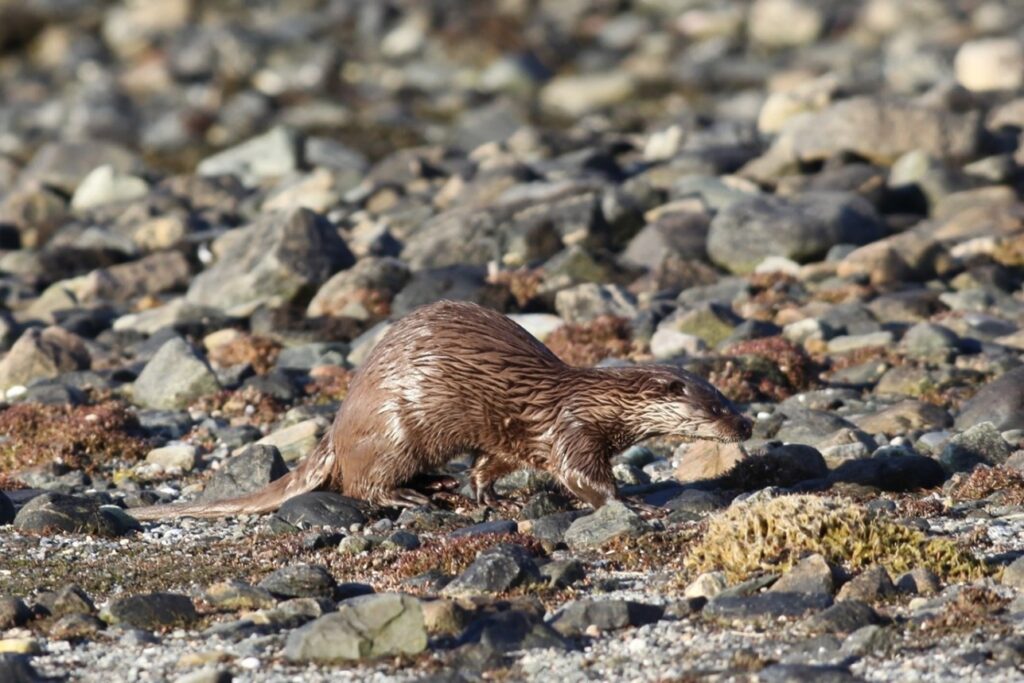
Photo: Per Jordhøy / Norwegian Biodiversity Information Centre.
The otter has few natural enemies. Still, the population was so low in 1982 that it was fully protected. The reason for this was mainly high hunting pressure. From 2010 to 2015 the otter was classified as a vulnerable (VU) species on the Norwegian Red List for Species. The protection led to such a rise in the population that in 2021, the otter could finally be removed from the Red List and classified as least concern (LC).