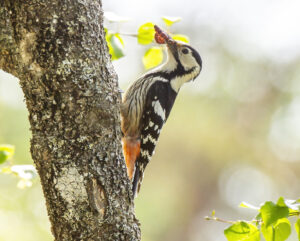

The white-backed woodpecker
The white-backed woodpecker (Dendrocopos leucotos) is the largest of the spotted woodpeckers in Norway. It can easily be confused with the far more common great spotted woodpecker, but it lacks the white shoulder spots of the great spotted woodpecker.
The white-backed woodpecker specializes in pecking out insect larvae from dead wood, preferably still standing, dead deciduous (broad-leaved) trees. Forestry is a threat to this woodpecker because trees are not allowed to stand until they die, and it has disappeared from Eastern Norway where it existed 40-50 years ago. However, the hilly terrain in Telemark and Agder offers better opportunities for steep deciduous forest slopes not to be felled. In such places, the white-backed woodpecker finds good living conditions.
The species currently has its best occurrences in coastal areas from Telemark to the Trondheim Fjord, and it is classified as Least Concern (LC) in Norway. In comparison, it is critically endangered (CR) in our neighbouring country Sweden, which lacks the heavily hilly coastal landscape where the species survives in Norway. The Swedes have even released white-backed woodpeckers bred in captivity, to save the species from becoming extinct in Sweden. Some of the chicks for this breeding project have been brought from Agder, among other places.
The white-backed woodpecker usually makes the nest hole higher up in the tree trunk than the other woodpeckers. Often, the nest hole is 12-15 m above the ground. The nest can be made in aspen, birch and in dry conifers.