
Minerals in pegmatites
Pegmatites are igneous rocks that have much larger grains or crystals than are common in rocks, meter-sized grains are not uncommon. The composition is usually granitic, but they can have other compositions as well, for example nepheline syenitic. The latter type can be found at Langesundsfjorden, from which more than 170 different minerals are known. In Norway, some granitic pegmatites have had economic significance, e.g. in the Tysfjord area in Nordland, in Østfold and several places in Agder. It is most often feldspar, quartz and partly mica that has been mined. The largest deposits in Agder are in Evje and Iveland, but there are also significant deposits in Froland, Birkenes, Lillesand and Flekkefjord.
Pegmatites are thought to form from the last residual melts after crystallization of a magma. They contain many late-stage crystallizing minerals that are not found in ordinary granites. Elements such as lithium, caesium, beryllium, boron, rare earth elements, niobium, tantalum, zirconium, thorium, and uranium can be enriched in pegmatites. Volatile phases such as water, fluorine and chlorine are also present, which help to lower the melting point of the minerals. These residual melts often penetrate cracks in the adjacent rock and form veins when they solidify. The reason why the grains become so large is that it is more likely that a molecule from the residual melt enters an existing crystal than that it joins with other molecules to form a new crystal.
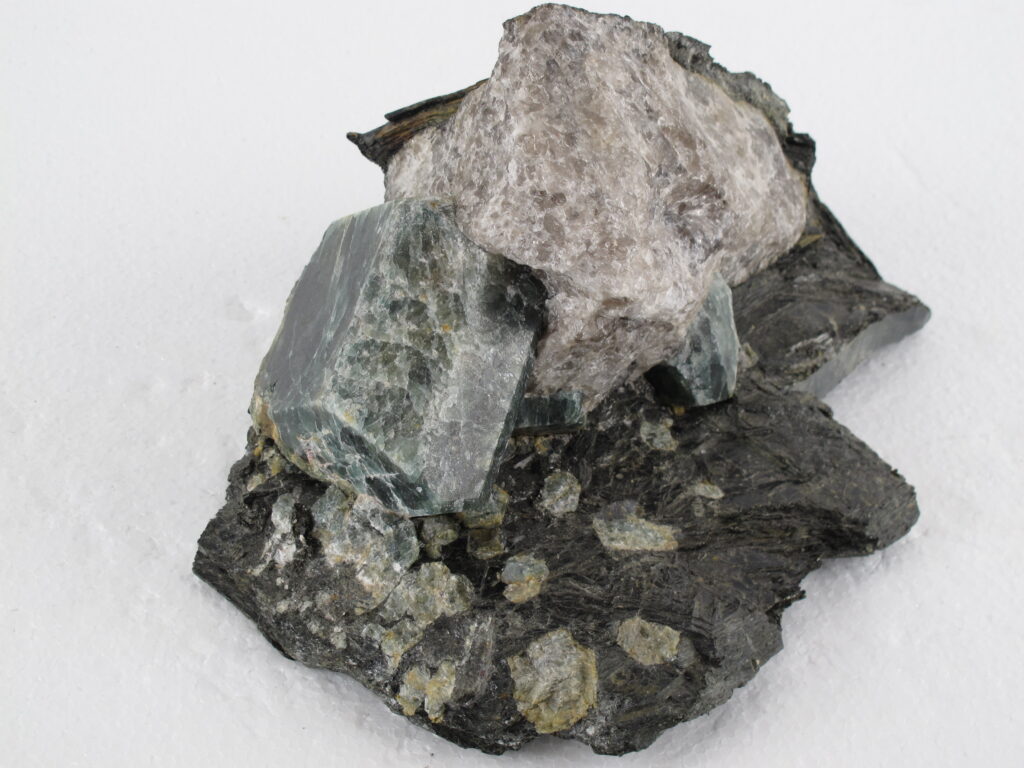
The display in the middle shows a few minerals that typically occur in pegmatites. All the minerals exhibited in this display are from deposits in Agder.