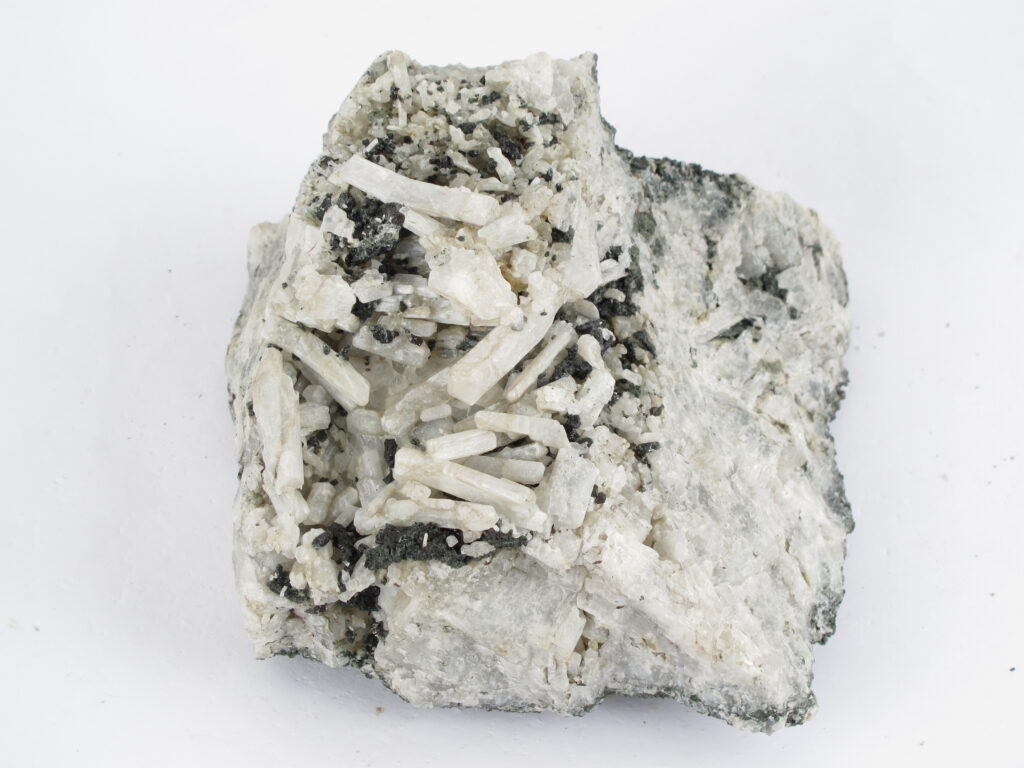

Minerals from skarns and hydrothermal deposits
Skarn is a rock that occurs when carbonate rocks (for example limestone, marble, and dolomite) react with silicate melts, or gases and fluids from these. The process is called metasomatism. Typical minerals in skarn deposits are grossular, andradite, diopside, epidote, wollastonite, scapolite, vesuvianite and ilvaite. In addition, ore zones are often linked to such deposits, such as, for example, the iron ore in the Arendal area. In addition to iron, there may be profitable deposits of copper, zinc, lead, tungsten, tin, molybdenum, and gold in some skarn deposits. Rare minerals can occur because the fluids that react with the carbonate rocks are often enriched in certain elements. Skarn deposits are common in the Kristiansand and Arendal area, in addition to the contact zones in the Oslo region.
Minerals that are formed hydrothermally are precipitated from aqueous, hot fluids that circulate in the Earth’s crust. Such mineral formations can occur in many different environments, and the fluids can originate from magmatic or metamorphic processes. They can also originate from pore water stored in marine sedimentary rocks that is mobilized due to heat from the Earth’s interior or other disturbances in the Earth’s crust. It can also be water that has seeped down from the Earth’s surface along cracks, faults or through permeable rocks (meteoric water). Depending on the depth at which the processes take place, the temperature during precipitation of hydrothermal minerals can vary between 50 °C and 500 °C. Quartz and calcite are common minerals in hydrothermal veins, but in addition to these many rare minerals may occur, including several that can be economically valuable if they occur in large enough quantities.
The display on the right shows a selection of minerals from skarns and hydrothermal deposits.