

GRASS SNAKE (Natrix natrix)
Description
The grass snake is the largest of the Norwegian snake species. The female is larger than the male, both in length and weight. The longest measured grass snake in Norway was 135 cm, however some claim to have found even longer specimens. The female typically measure about 105-115 cm and weight between 250 and 420 grams.
The male is usually about 55-70 cm long, and weighs only 30-60 grams. The grass snake is a slim and elegant snake, particularly compared to the Northern viper that has a more bulky body.
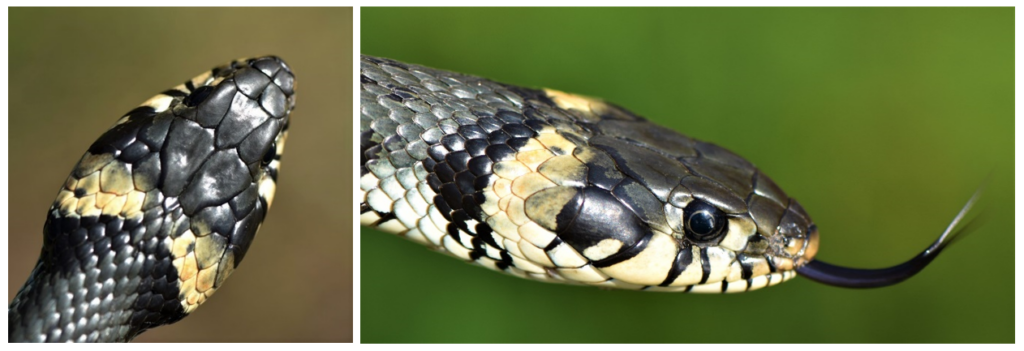
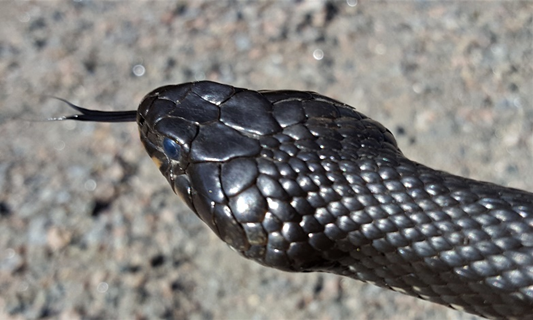
The grass snake can be completely black. This is calles melanism. A melanistic grass snake does not have spots on it’s neck. This is quite common in the south of Norway, along the coast. The adults can have white-yellow spots, but with age they can fade and become less an less visable. At the end, the grass snake can appear almost completely black.
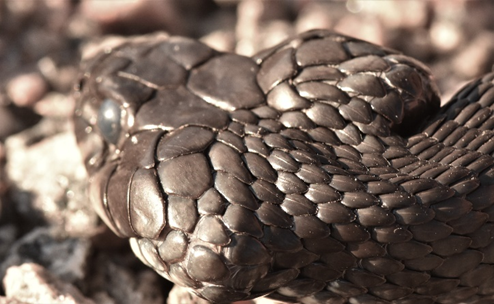
Compared to the Northern viper, the grass snake has few and large scales on it’s head. The Northern viper has small and many scales.
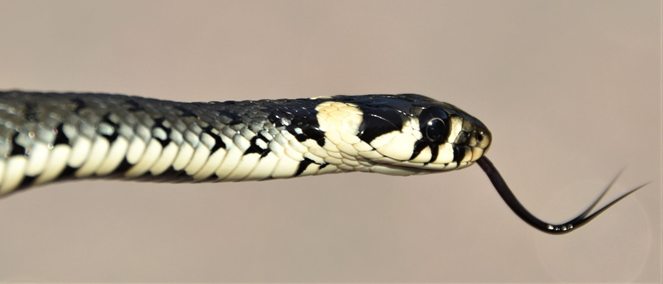
The colour in the back is usually grey or black, but can also appear greenish. The grass snake usually has small black spots on the back, as can be seen in the picture.
The grass snake has round pupils.
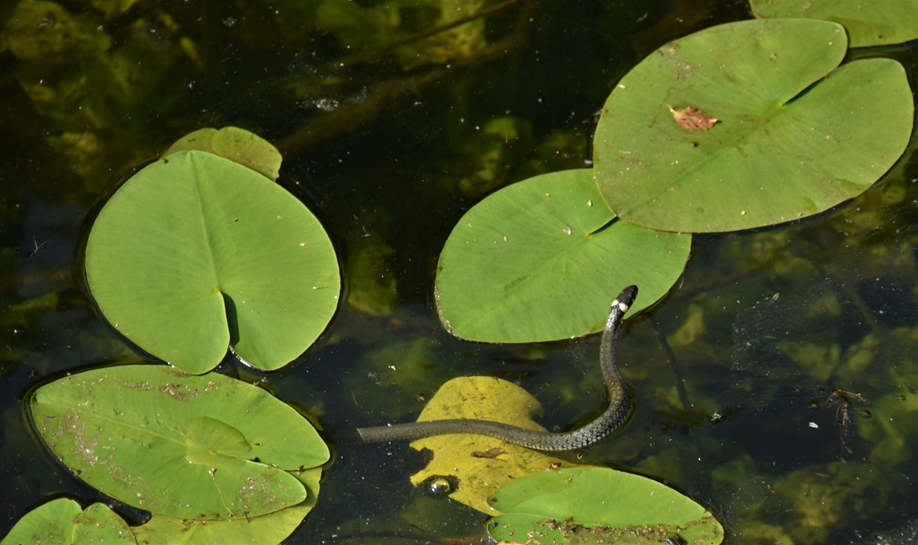
Our quickest snake is a water snake!
The grass snake is the quickest of the Norwegian snakes. If you spot a snake that disappears quickly, and throws itself into the water, then you have probably saw a grass snake. The grass snake is a good swimmer both above and below the water surface. They catch and eat small fish, toads, frogs and salamanders. The grass snake belongs to the genus “Natrix”.
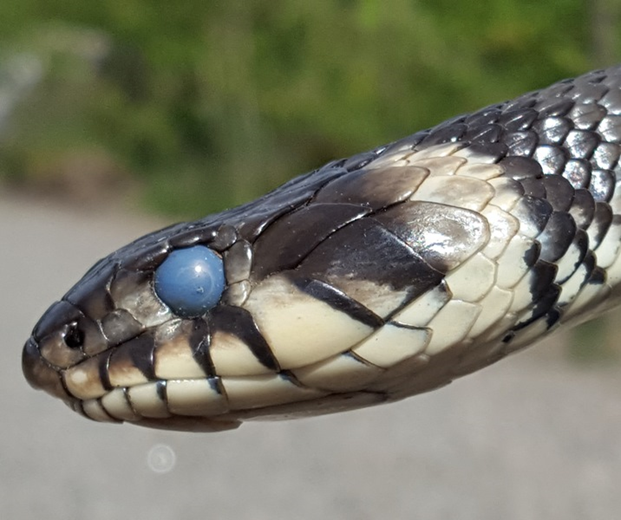
Blue eyes when shedding
All Norwegian snakes shed their skin twice during the summer. Snakes that find lot of food can shed even more often. Subadults can shed skin more often.
New skin is formed under the old skin. A few days befor the old skin is shed, a layer of fluid will form between the two skins.
When shedding, the eyes of the snake gets a blue colour, this i due to the fluid layer. During this time, the snake can’t see as good as it usually does.
Play dead
The grass snake is quick, naturally it’s main defence against dangers, is escaping. However, when this tactic does not work, they have an alternative one: To play dead. This phenomenon is called “death fainting”.
When the grass snake plays dead, it tryes to look like a cadaver. Additionally, it releases a smelly liquid from its cloaca. The discharge reeks of death – a truly horrible smell!
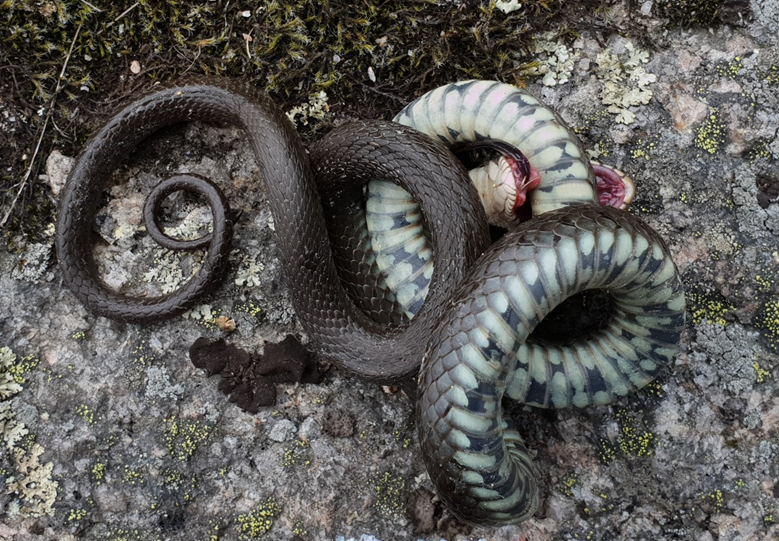
When the grass snake plays dead, it will get on it back, exposing it’s abdomen, and open it’s mouth, tongue hanging out. It will stay like this until it believes the danger has passed.
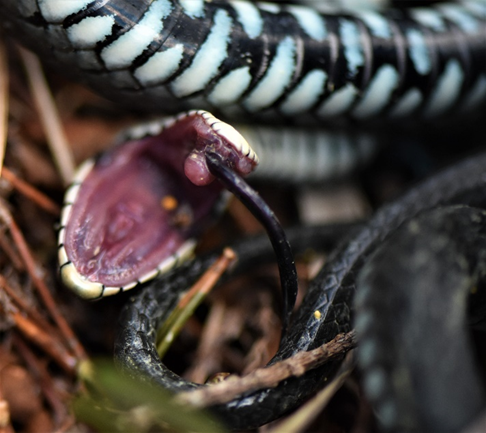
If the grass snake choose another tactic, it may try to look intimidating. It can push out the sides of it neck and hiss to appear scary.
Mating in a “Mating Ball”
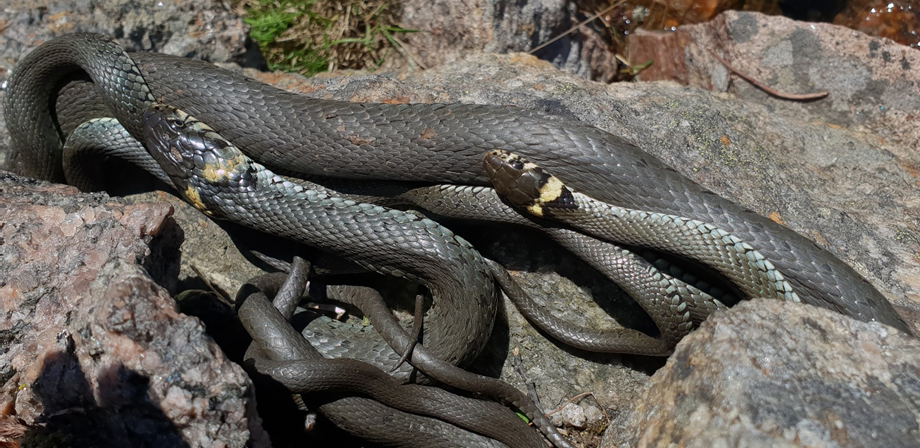
The grass snake emerges later in the Spring than the Northern viper. Along the Norwegian southern coast, they usually appear in April. Both males and females appear at the same time, and mating season starts instantly.
A fun fact about the mating of grass snakes, is that multiple males will attempt mating with a female at the same time. It can be as many as 10 small males attempting to mate with one large female, resulting in one big lump of snakes. This phenomenon is called a “mating ball”.
The grass snake will not mate during cold or bad weather. However, when the sun is out, many “mating balls” can be spotted in April and May.
The grass snake is usually a particularly shy individual, which will slither away as soon as you spot them. However, this is not the case for the males during mating season. During mating season, they can be spotted quite easily. They can even lick your finges if you get close enough!
The grass snake lays eggs
The grass snake is the only Norwegian snake which lays eggs. The eggs are not hard or solid like chicken eggs, but feels more like soft leather.
The female will lay the eggs in June-July, in a warm spot. Example of places would be a sunny tuft of heather, a crack in rock or mountain, a pile of manure or a pile of seaweed by the ocean.
The grass snake typically lay 10-20 eggs. The larger females lay more eggs than the younger and smaller ones. The eggs takes approximately a month to hatch. The snakelets has an egg-tooth which they use to cut an opening in the eggshell. They lose the tooth a while after hatching.
Piano keys on the belly
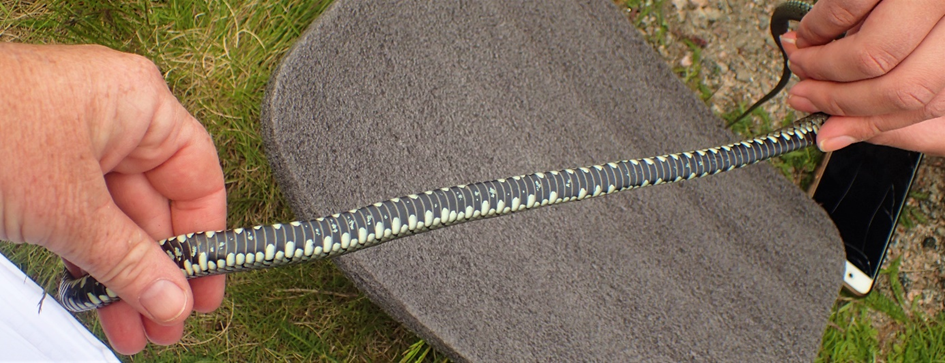
The grass snake has a particular pattern on it’s abdomen. The Northern viper has a fully black abdomen. The smooth snake has an orange-yellow colour. The grass snake, on the other hand, has a pattern closely resembling piano keys.
These black and white areas stays the same throughout it’s life. The pattern is different for each individual, and can be used for recognising each individual. By taking a picture of the lower 20cm of the abdomen, a specific grass snake can be recognised many years later.
Text and photo: Beate Strøm Johansen