

Communication
Marine mammals are using sound for orientation, finding prey and to communicate. They use sound because it is far more effective (speed and distance) than eyesight and smell in water.
Pilot whales (and other dolphins and whales with teeth) are use high and low frequency clicks. The high frequency (short wavelength) clicks are used for echolocation, the low frequency clicks (long wavelength) are used to find out how far things are away. Clicks with a long wavelength can travel very far, short wavelength clicks are giving the whale much detailed information.
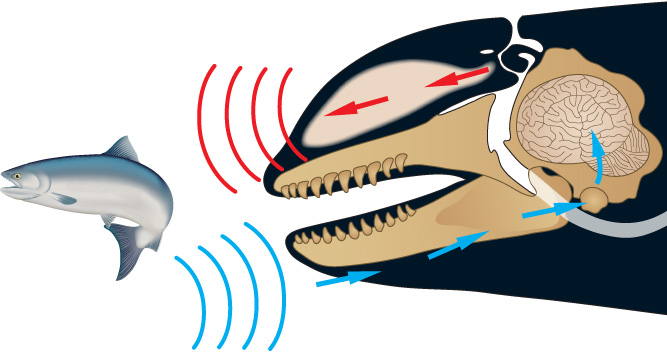
Picture: seawatchfoundation.org.uk
The sounds pilot whales make are produced by an airflow through the phonic lips (also called Monkey lips). The phonic lips act more or less similarly to human vocal cords. When air passes through this narrow passage, the phonic lip membranes are sucked together. This causes the surrounding tissue to vibrate witch produce the sound. These vibrations are send to ‘the melon’ which forms a ‘beam’ of it.
Pilot whales have two sets of phonic lips so they can produce two sounds at the same time.
Pilot whales use sound as well to communicate with each other. Not all pilot whales are producing the same sound. Even pods of whales living more or less in the same area make different sounds, they have dialects.

Picture: researchgate.net, Uko Gorter Natural History Illustrations