
Minerals in metamorphic rocks
Metamorphic rocks dominate the bedrock in Agder and the rest of Norway. These are rocks that have had their structure and mineral composition changed due to changes in pressure and temperature, often during deformation. The degree of transformation can vary regarding both pressure and temperature. The temperature can vary between 200 °C and 900 °C but is never so high that the rock melts. Then we are over in the magmatic regime. The pressure can vary from very low near the Earth’s surface to more than 2 gigapascals at depths greater than 60 km. The gneisses and amphibolites in Agder were probably formed by transformation that took place 15-20 km below the surface at 500 – 600 °C.
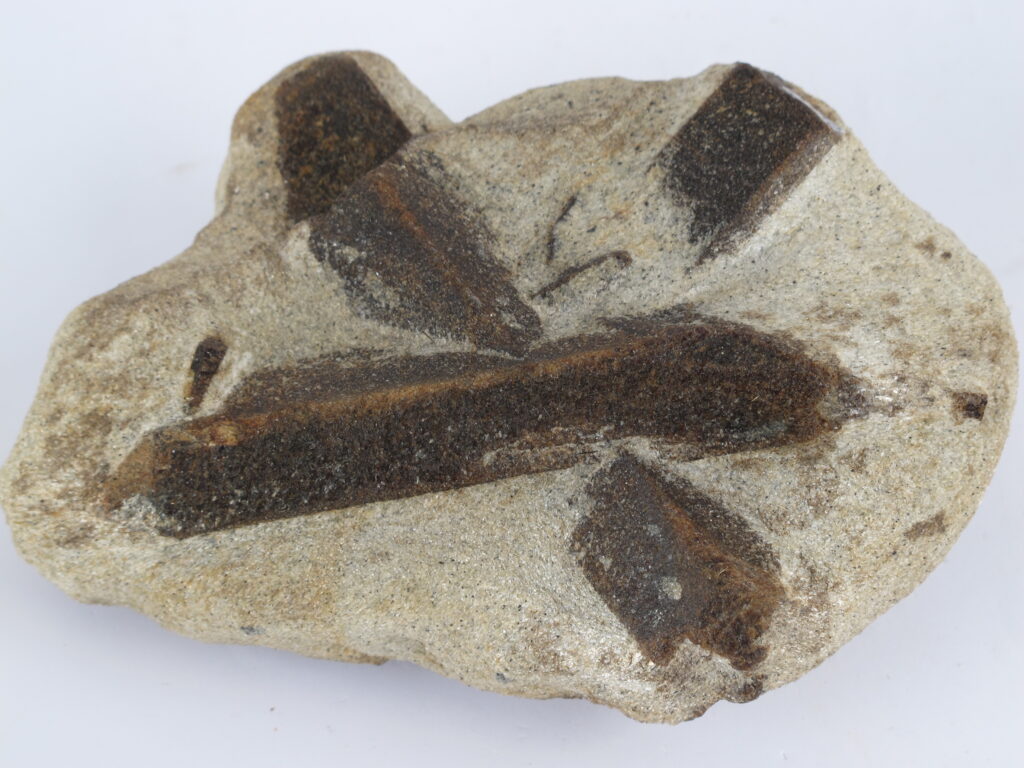
Certain minerals can be said to be index minerals, i.e. characteristic minerals for specific pressure and temperature conditions. What are index minerals will also be determined by the rock’s chemical composition. An acidic rock (for example granite) will gain different index minerals during metamorphism than a basic rock (for example basalt or gabbro).
The display on the left shows several minerals that can act as index minerals in metamorphic rocks. We show the entire range from low-grade metamorphism (the zeolite natrolite as an example) to high-grade metamorphism (with the high-pressure rock eclogite as an example).